

Dental Aftercare Guide
Learn more about how to recover after a treatment with our dental aftercare guide for tooth extractions, teeth whitening and root canal for long lasting results.
By:
Updated:
Tooth Extraction aftercare
What is the best aftercare for a tooth extraction?
After a tooth extraction, the first 24-48 hours are the most critical for quick recovery and healing. The main aim is to protect the blood clot that forms in the socket site; if the clot is dislodged it can lead to “Dry Socket” which is very painful.
Dos and don’ts after tooth extraction
Do’s after tooth extraction:
- Keep pressure initially on the socket site. If it does start bleeding later when you’ve left the surgery, bite firmly on the spare gauze pad we provide for at least 30-60 minutes.
- Cold Compress – Apply an ice pack/ cold towels on your face next to the extraction site for 10-15 minutes at a time. Do this during the first 24 hours to reduce the swelling.
- Eat Lukewarm Soft Foods – Stick to these kinds of foods like yoghurt, mashed potato, soup, or smoothies.
- Rest keeping your head elevated. Slow gentle movements for the first day as a high heart rate can cause the socket to bleed again.
- Saltwater Rinse (not for the first 24 hours) – mix some salt (1/2 a teaspoon) in a glass of warm water. Lean your head over the sink so the water falls out with gravity – do not spit out.
- Take pain medication to help ease the discomfort during the first 72 hours. Sometimes antibiotics are also prescribed if a surgical procedure – take as recommended by your dentist.
- Line your pillow on your first night post extraction – sometimes your saliva can be slightly tinged with blood.
Don’ts after tooth extraction:
- Don’t spit or rinse vigorously/excessively: This creates negative pressure which can dislodge the blood clot and cause bleeding or delayed healing.
- Don’t poke the area: Its tempting but keep your tongue, fingers and toothpicks away from the extraction to minimize infection. This includes not dabbing the area with a tissue!
- Don’t smoke for at least 72 hours. Nicotine delays healing, and the sucking action can pull out and disrupt the blood clot.
- Don’t drink alcohol or hot liquids. These can thin the blood, dissolve the clot and start bleeding of the socket site. Keep drinks on the colder side.
- Don’t use a straw and drink directly from a glass for 72 hours. The suction within this time pulls out the blood clot and can increase risk of dry socket.
How to clean the extracted tooth area
This needs a gentle approach – the first 24 hours keep brushing away from the extraction site (but do brush your other teeth!).
Do not rinse within the first 24 hours.
After 24 hours, you can dissolve 1/2 a teaspoon in a glass of water and do a gentle saltwater rinse. Take a sip, tilt your head from side to side (so the water bathes but does not disrupt the socket site), and then lean over the sink and let water fall out of your mouth with gravity. Try to do this 4-5 times a day especially after you have eaten.
After a week gently you can let your toothbrush bristles clean over the socket (ideally a manual brush).
What to eat after tooth extraction
For the first 24 hours: stick to cool liquids and very soft foods like smoothies, yoghurt, blended soups, or even ice cream (the cold helps reduce the swelling and bleeding).
Days 2-4: go for mushy foods like mashed potato, scrambled eggs, overcooked pasta or soft fish.
For at least 7 days avoid:
- Crunchy and sharp foods (e.g. crisps, crusty bread and popcorn) that can poke the healing socket site
- Small seeds and grains (e.g. rice quinoa, flax seeds) which can get trapped in the socket and cause infection.
- Chewy/Sticky foods like toffee or gummies – These can dislodge the blood clot, delaying the healing of the extraction site.
How soon can I drink water after tooth extraction?
You should really wait till after your numbness has worn off before you try and drink. To support quick healing post tooth extraction, we recommend hydrating with room-temperature water. Please sip directly from a glass, swallow gently and avoid using straws for at least 72 hours. Water is ideal as it is sugar free and non-acidic.
What does the tooth extraction healing process look like?
- Day 1: there should be a dark red/purplish “jelly-like plug” in the extraction site – do not disturb this.
- Days 2-3: the site starts to look creamy/white – this is granulation tissue – a mix of collagen, white blood cells and tiny blood vessels. Swelling at this point is at its peak so cold compress is useful.
- Days 7-10: the socket hole starts to heal inwards and the colour of the gum changes to a healthy pink colour. Gum swelling also reduces.
- Weeks 3-4: Gum fully closes over but there is often a small indent in the middle of the socket site.
What is the best mouthwash to use after a tooth extraction?
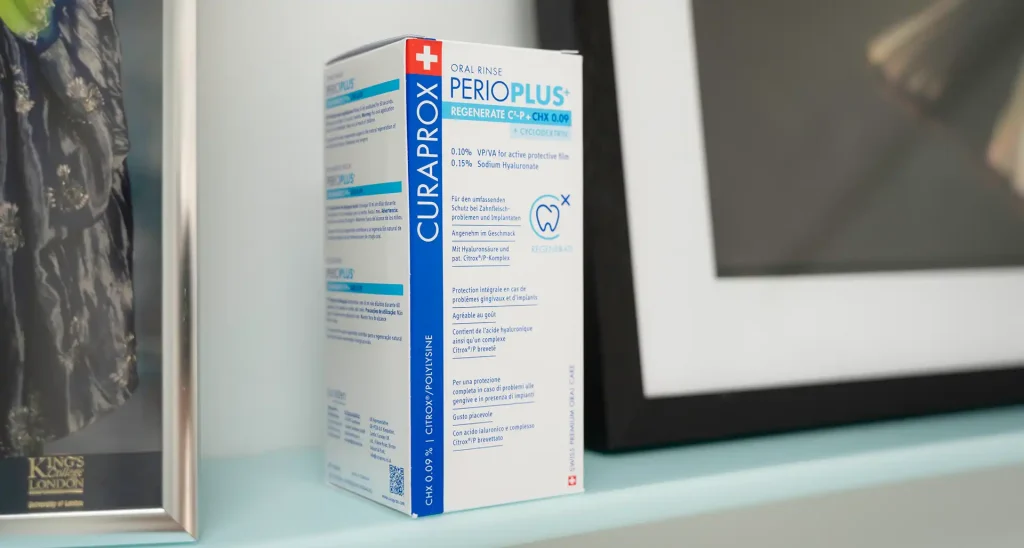
After the first 24 hours: saltwater mouthwash is both safe and effective for the healing process. If you are at a higher risk of infection, we may advise you to use Perio Plus Regenerate mouthwash which contains Chlorhexidine and an anti-stain formula (unlike original Corsodyl). Perio Plus Regenerate also has hyaluronic acid which helps tissue repair and keeps the mouth moist.
Avoid: mouthwashes containing alcohol or hydrogen peroxide as they can dissolve the blood clot and increase risk of dry socket. Do not spit mouthwashes out during the first 72 hours but instead hold your head over the sink and let the liquid fall out of your mouth.
When should I be worried and call the dentist after extraction?
You should contact your dentist if you notice signs of complications after tooth extraction such as infection, dry socket, or uncontrolled bleeding.
- Severe pain that is not helped by regular painkillers (prescribed or OTC – over the counter).
- Heavy bleeding that does not stop after biting on gauze for 30 minutes.
- Fever, Chills or Nausea which could be an infection.
- A foul taste or smell coming from the socket site.
- If the site looks “dry” and you can see white bone instead of a dark clot (accompanied by intense pain).
Teeth whitening aftercare
Do and don’ts after teeth whitening?
During and for two days following whitening treatment, tooth enamel is temporarily more porous, making it act like a sponge for stains.
Do’s After Teeth Whitening Treatment
After your professional teeth whitening treatment, it’s important to take proper care of your teeth and manage sensitivity to maintain the results.
Here are some things you should do:
- Eat light coloured food and drinks with minimal/no colouring like potato and pasta; if sauces are used they should be ideally white/beige.
- If you eat something with colouring, rinse your mouth out with lukewarm water immediately after.
- Keep hydrated by drinking plenty of still water.
- Use a straw when drinking, brush gently with a soft toothbrush and non-abrasive fluoride toothpaste. If teeth are sensitive during the whitening process, use a desensitizing toothpaste (e.g. Colgate Sensitive Instant Relief or Sensodyne Repair and Protect) or a desensitizing pen (e.g. Enlighten Comfort). You can take a small amount and dab it over the sensitive spot.
- Keep up with flossing daily.
Don’ts After Teeth Whitening Treatment
After teeth whitening you should avoid acidic things like citrus and vinegars which can increase sensitivity.
In addition, don’t:
- Eat and drink dark staining items like coffee, tea, red wine, dark sauces (soya and tomato) and curries.
- Smoke or Vape – Tobacco and nicotine stains and yellows your teeth.
- Use lipsticks/glosses that can also stain your enamel.
- Have extremes of hot and cold to eat/drink during whitening as these can set off sensitivity.
Long-term Maintenance tips after teeth whitening
Professional teeth whitening results usually last from 6 months to a year, depending on your habits. To keep your smile from fading back to its original shade, we recommend the following:
- The rinse/straw rule: if you drink something with staining, rinse your mouth immediately (ideally within 30 minutes). Try not to brush it off especially after acidic things like coffee/wine as this can scrub off some already softened enamel. Else you can use a straw which prevents direct contact with your teeth.
- Upgraded oral hygiene: electric toothbrushes are superior at removing plaque which can attract stains. Flossing daily will help, as stains start in between your teeth.
- Avoid: tannins (in tea/wine), chromogens (berries and soy sauce) and acidic foods (which thin out the enamel allowing stains to penetrate through).
- Professional boosters/top-ups: regular hygiene cleans (as recommended by your dentist) and syringes of whitening gel (which can be used with your previously made custom trays).
How long does it take for tooth pores to close after whitening?
It takes approximately 48 hours for the dentinal tubules (“pores in your teeth”) to close after professional tooth whitening. During this time the surface of your teeth are like a sponge and will pick up colour pigment.
During this time avoid colouring foods (they can discolour your teeth quickly) and acidic foods (which causes sensitivity and increased risk of staining).
After 2 weeks, the colour and oxygen level stabilises – which is a good time to get any composite bonding or fillings.
Will my crowns/veneers / composite fillings change colour?
They won’t change colour, sadly. Only your natural tooth enamel changes colour with peroxide gel; it has zero effect on the materials used for dental restorations (which are colour-stable). For this reason, we recommend that you let us know if you want to use tooth whitening treatment in the future, so we can plan for any cosmetic work done to match up your newly whitened teeth.
Sometimes a Prophy-Jet hygiene clean (air polishing) can polish away some surface stains on the filling surface to help it blend in with your whiter tooth colour. While it won’t change the colour of the composite/porcelain, it can make teeth look significantly brighter if they were just dull from coffee or tea buildup.
If pre-existing fillings are on your front teeth, you should be aware that you may need to replace these fillings after whitening to match your new shade. Ideally wait 2 weeks after completing whitening to allow the whitened colour to “settle”. This 14 day period also allows the enamel to rehydrate and release residual oxygen (to get the best bond for your new composite fillings).
root canal aftercare
What are you not supposed to do after a root canal?
After a root canal treatment has been done on your tooth, it is important to protect your tooth until your dentist can crown/onlay it.
Main things to avoid after a root canal are:
- Eating/Drinking till you have full sensation back after the anaesthetic so you don’t accidentally bite your tongue, cheek or lip
- Eating crunchy, hard or sticky foods as the tooth is prone to cracking
- Eating on the side of the root canal – avoiding putting unnecessary pressure on the temporary filling
- Heavy exercise for 24 hours – physical activity can increase the chance of pain
- Smoking or using straws – both can delay healing – suction can actually dislodge the temporary filling or irritate the site where the local anesthetic was injected.
Can a root canal cause ear pain?
Yes, root canal can cause ear pain, where the ear aches or throbs. This can occur as:
- The teeth, jaw and ears all share the same nerve network (trigeminal nerve). So the brain can sometimes struggle to pinpoint the source of the pain especially if the tooth is a back molar.
- During the root canal, the mouth is kept open for a long time which can put stress on the TMJ (temporomandibular joint). Joint inflammation or muscle fatigue can radiate to the ear.
- After the root canal, the tissues around the root are still alive and so temporary inflammation can put pressure on nerves that lead to the ear.
If pain is mild-moderate for a few days post root canal this should respond to anti-inflammatories. If after the 3rd day the pain is getting worse or with some swelling, it could mean there is an infection or high filling.
What is the fastest way to recover from a root canal?
For a quick recovery from root canal:
- Take anti-inflammatories: such as Ibuprofen (if suitable), otherwise take Paracetamol – please check with your dentist/pharmacist) whilst you are still numb after the procedure as this prevents rebound pain
- For the first 24 hours: use an ice pack on the outer jaw next to your tooth that has had treatment. (15 minutes on and then 15 minutes off)
- After 24 hours: use a warm compress to relax your muscles
- Keep your head elevated the first couple of nights after your root canal which reduces the pressure and helps drainage of minor swelling
- Saltwater mouth rinses for a few days post root canal
- For the first 24 hours avoid exercise, smoking and alcohol.
- For a few days stick to soft foods where you don’t need to chew and avoid using a straw
What are the red flags after a root canal?
It’s quite normal to feel some “bruising” or tenderness for 3-5 days after a root canal. However, if you experience any of the following you should contact your dentist immediately:
- An uneven bite (likelihood is that the temporary filling is high) – you should call the dentist immediately rather than waiting
- Visible swelling inside or outside the mouth (i.e. face, cheek or neck)
- Pain that gets worse, not better especially after a few days
- “Pimple” on the gums near the treated tooth
- Running a fever, having chills or feeling extreme fatigue
- Foul Taste or Odour coming from the tooth
- An allergic reaction (rash or itching)
- The temporary filling comes out completely
dental filling aftercare
How long to rest after a tooth filling?
There are two types of rest to consider:
- Physical Rest (Exercise): You can usually return to work or school immediately. However, avoid intense exercise for a few hours; increased blood pressure can sometimes cause a newly filled tooth to ache or throb.
- Resting the “Bite”: Wait for the numbness to wear off before eating. While white fillings are instantly set 100% with a UV light, we recommend sticking to soft foods for the first few days to let the tooth “settle”.
- Note: If you were sedated (beyond just local anaesthetic), you must rest for a full 24 hours and avoid driving.
What should you not do after having a filling?
To prevent pain or damage to your new restoration:
- Don’t eat while numb: This prevents accidental (and often severe) lip or tongue biting.
- Avoid temperature extremes: The nerve is often sensitive from the drilling; give it a few days to calm down.
- Avoid hard or sticky foods: For the first few days, skip the toffees, nuts, or crusty bread to avoid “popping out” or cracking the new material.
- Don’t wait to report a “high bite”: If your teeth hit the new filling “early”, call us immediately. Chewing will not grind it down, but it will bruise the tooth ligament and cause sharp pain.
- Don’t use teeth as tools: Avoid opening packets or biting fingernails, as this can easily chip the filling.
Can you eat after a filling?
Yes, but the “when” depends on the numbness.
- The 2-Hour Rule: If you had a local anaesthetic, wait until the numbness has worn off (usually 2 hours). If you are starving, stick to lukewarm liquids like soup or smoothies—but avoid using a straw while numb, as you may accidentally bite your lip.
- Short-Term: For the first 24 hours, stick to soft foods and try to chew on the opposite side of your mouth.
- Long-Term: To maximise the lifespan of your filling, try to limit very sticky or excessively hard foods.
How to care for teeth after a filling?
For the first 24 to 48 hours, be gentle to allow the nerve and surrounding tissues to settle:
- Gentle Hygiene: Use a soft-bristled toothbrush and floss carefully (don’t “snap” the floss into the gums).
- Soothe the Gums: Use warm salt water rinses to help the injection site and gum tissue heal.
- Sensitivity Management: Use a desensitising toothpaste (like Sensodyne Rapid Relief or Colgate Sensitive Instant Relief) for the first week if you experience “zingers” with cold air or drinks.
What to do if you have pain after a filling?
Minor, temporary discomfort is normal for 48 to 72 hours. Here is how to identify and manage it:
- Sensitivity to Hot/Cold: Sharp pain that vanishes quickly.
Management: Rub desensitising toothpaste directly on the tooth and avoid extremes for a few days. If it persists for weeks, the filling may be deep and require a review. - Pain When Biting (The “High Filling”): Sharp pain only when chewing or when teeth touch.
Management: This requires a quick “bite adjustment” at the clinic. It takes minutes and provides almost instant relief. - Dull Ache or Throbbing: A constant, heavy, pulsating feeling.
Management: This can be a sign of an inflamed nerve. Anti-inflammatories (if safe for you) can help, but you should call the dentist as you may need further treatment. - Gum Tenderness: Soreness at the injection site.
Management: Use warm salt water rinses 3 times a day.
Call your dentist as an emergency if you experience:
- Visible swelling of the gum, cheek, or jaw.
- A fever or general “flu-like” feeling.
- Signs of an allergic reaction (rash, itching, or difficulty breathing).
- Pain that is getting significantly worse rather than better.
dental cleaning aftercare
What not to do after teeth cleaning at the dentist?
To keep your smile bright and minimise sensitivity after cleaning, we advise the following for a few days:
- Avoid staining foods and drinks: Your teeth have temporarily lost their protective pellicle layer and are more porous.
- Avoid acidic foods/drinks: These can increase sensitivity and “zingers.”
- Avoid extremes of temperature: Stick to lukewarm items to minimise thermal sensitivity.
- Avoid abrasive and spicy food: These can irritate tender or inflamed gums.
- Be gentle: Brush with a soft-bristled toothbrush and avoid aggressive flossing for 24 hours.
How long do you have to wait to eat after the dental hygienist?
Generally, you can eat or drink immediately after your cleaning. However, if you have a local anaesthetic, we recommend you wait until the numbness has completely worn off (usually 2–3 hours) to avoid accidentally biting your cheek or tongue. If you had a fluoride treatment, please wait at least 60 minutes before eating or drinking. When you do eat, stick to soft, non-acidic, and lukewarm items.
How long does it take for gums to heal after a hygienist?
This depends on how much “work” the hygienist did. If you visit regularly, you will likely feel back to normal immediately. If it has been a while since your last visit and there was significant buildup (especially under the gum line), your gums may be tender and may bleed slightly during brushing for a few days. After about a week, the tissue will firm up and feel healthy again. Note: Healing can be delayed by poor oral hygiene, smoking/vaping, or underlying conditions like diabetes.
How to soothe “angry” gums after a hygiene clean:
If your mouth feels “beaten up,” try these steps:
- Saltwater rinses: Use ½ tsp salt in warm water to kill bacteria and reduce swelling.
- OTC painkillers: Ibuprofen is generally better for gum inflammation than paracetamol (check with your pharmacist first).
- Extra soft toothbrush: We recommend a brush like the Curaprox CS 5460 for the first few days to be ultra-gentle on the tissue.
What does proper hygiene and aftercare for aligners (Invisalign) involve?
You must keep both your mouth and your aligners pristine to avoid trapping bacteria and sugar against your enamel, which causes cavities and “aligner breath”.
- Watch your drinks: Only drink plain, lukewarm, or cold water while wearing aligners. Hot drinks can warp the plastic. For anything else, remove the trays first.
- The “Clean-In” Rule: Ideally, brush your teeth after every meal before putting aligners back in. If you can’t brush, rinse vigorously with water and chew sugar-free gum to clear debris.
- Rinse immediately: Rinse saliva off your trays every time you remove them to prevent odour and cloudiness.
- Cleaning the trays: Use a soft brush and mild antibacterial soap twice a day. Avoid toothpaste, as its abrasive particles can scratch the plastic and make it look cloudy.
- Weekly soak: A few times a week, use a specialised cleaning tablet (like Steradent) to deep-clean the trays while they effervesce.
Step into Mayfield Dental
Contact our team today to arrange your consultation and discover expert cosmetic, restorative, and general dentistry.

Dr. Deepali Patel
Principal dentist at Mayfield Dental
BDS (Lond) 2006 | GDC No. 103927